
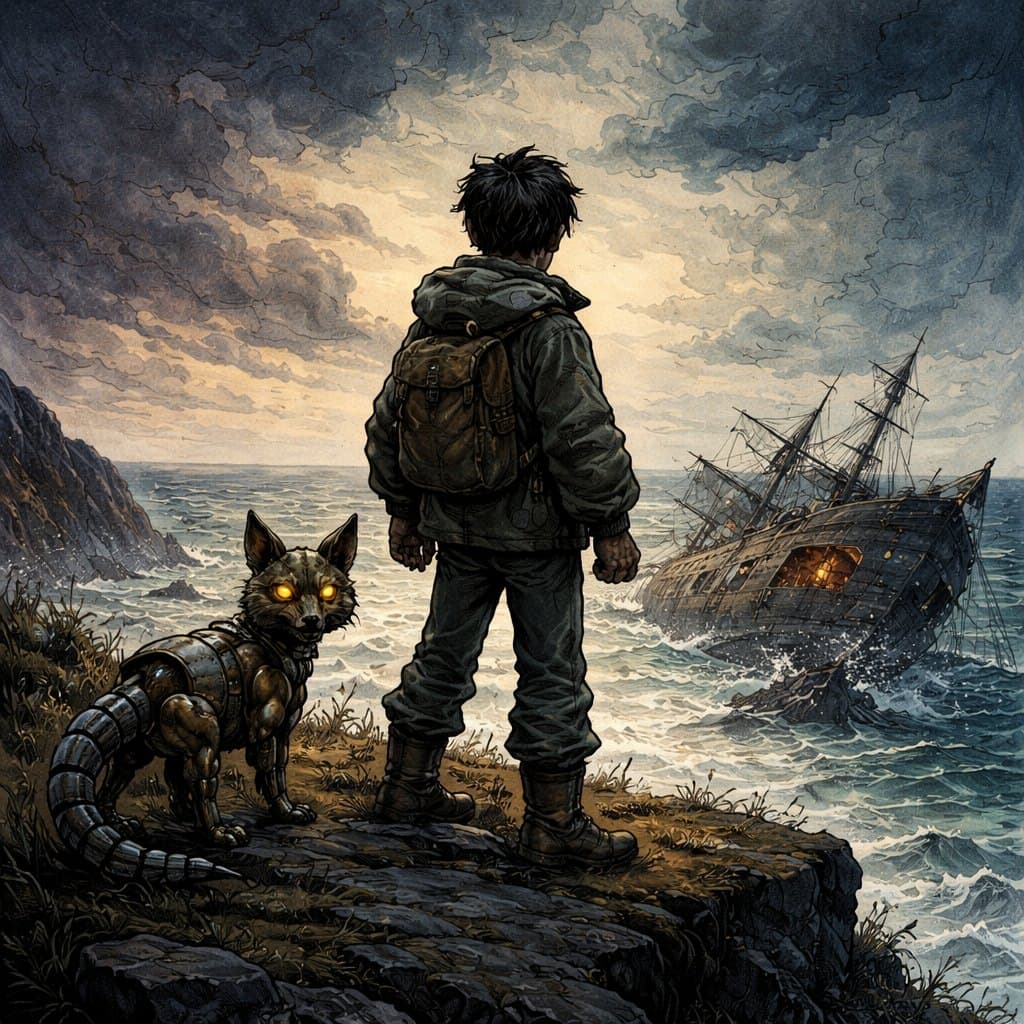
Theo and the Signal Fox
The wrecks came ashore on the north cliffs about once a month, and Theo was always the first one down.
He had a system. He watched the sky from the ridge above his grandmother’s house, and when something came down trailing smoke he counted the seconds until he heard it. Then he took the coast path with a canvas satchel over one shoulder and Rook trotting at his heel.
Rook had been his mother’s.
She built him the year before she died — a mechanical fox of brass and grey steel, with a tail of segmented cable that swung when he walked. One glass eye had cracked across the middle in a fall two winters ago, and the light behind it glowed brighter on the undamaged side.
Rook did not talk. He was not that kind of machine. But he had opinions about where Theo should walk, and he expressed them by standing in the way.
Which was exactly what he was doing now.
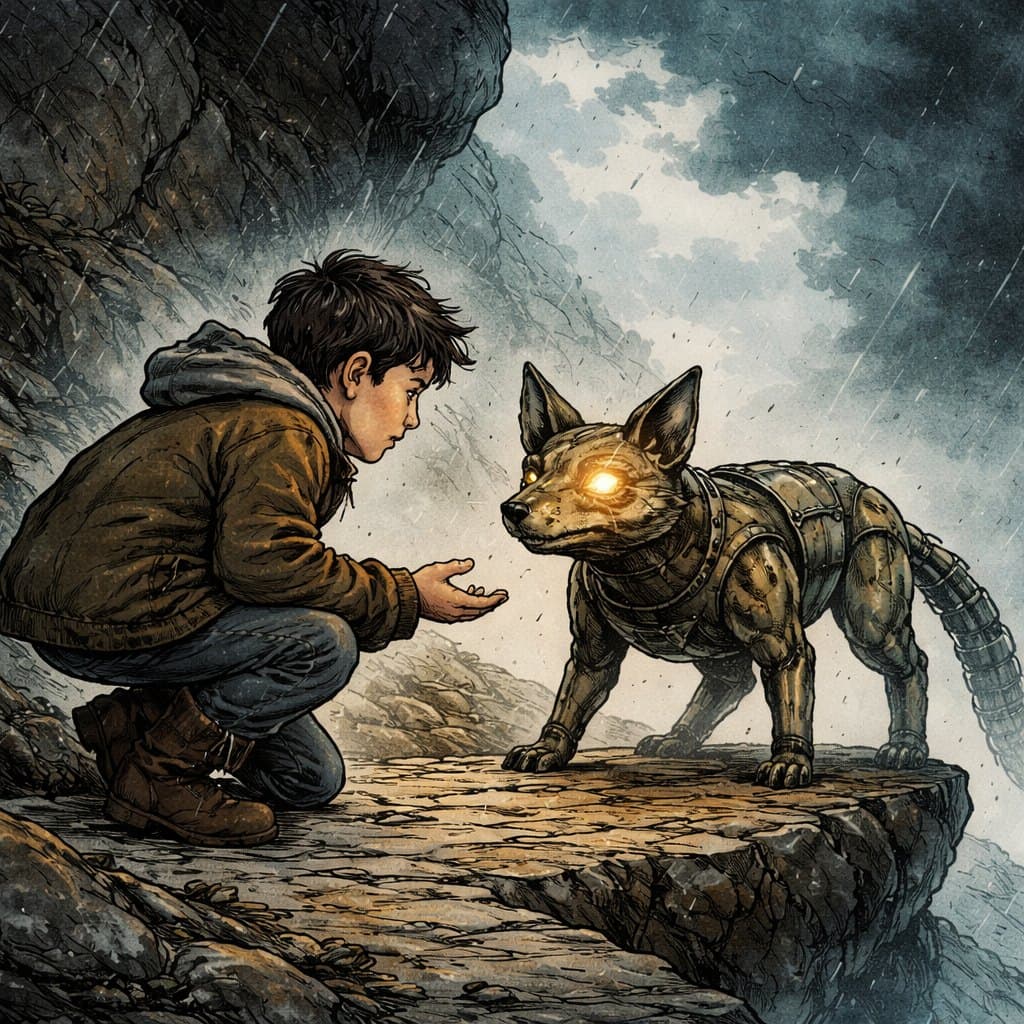
“Move,” said Theo.
Rook did not move. He had planted himself across the narrow part of the path, head low, cracked lens glowing faintly, cable tail completely still.
Below them, the wreck lay half in the surf. It was the best one Theo had ever seen — a long-hauler, split along the spine, one engine housing sitting clear of the water with its casing peeled open like a tin.
He could see brass from where he stood. Enough brass to get them through the winter.
“There’s a storm coming,” Theo said. “I know. I can see it too. That’s why we have to go now.”
Rook stayed where he was.
Theo crouched down in front of him, sleeves hanging over his hands. “One hour. Then we go up. I promise.”
He stepped around the fox and started down.
Rook followed. He always followed. That was the part Theo would think about later.
The shingle slid under his boots. Spray came over the outer rocks in sheets. But the brass was there — a whole rack of regulators, still seated, untouched.
Theo got the satchel open. The first one came free easier than he expected. Then the second.
He was reaching for the third when Rook made a sound.
It was not a sound Rook had ever made. It came out of his whole chassis, low, and it went on.
Theo looked up.
The sea in front of the wreck had gone flat.
Not calm — flat. Pulled down and drawn back, the way water goes when something very large is coming and has not arrived yet.
Theo had lived on this coast his whole life. He knew what that meant.
He got four steps before it hit.
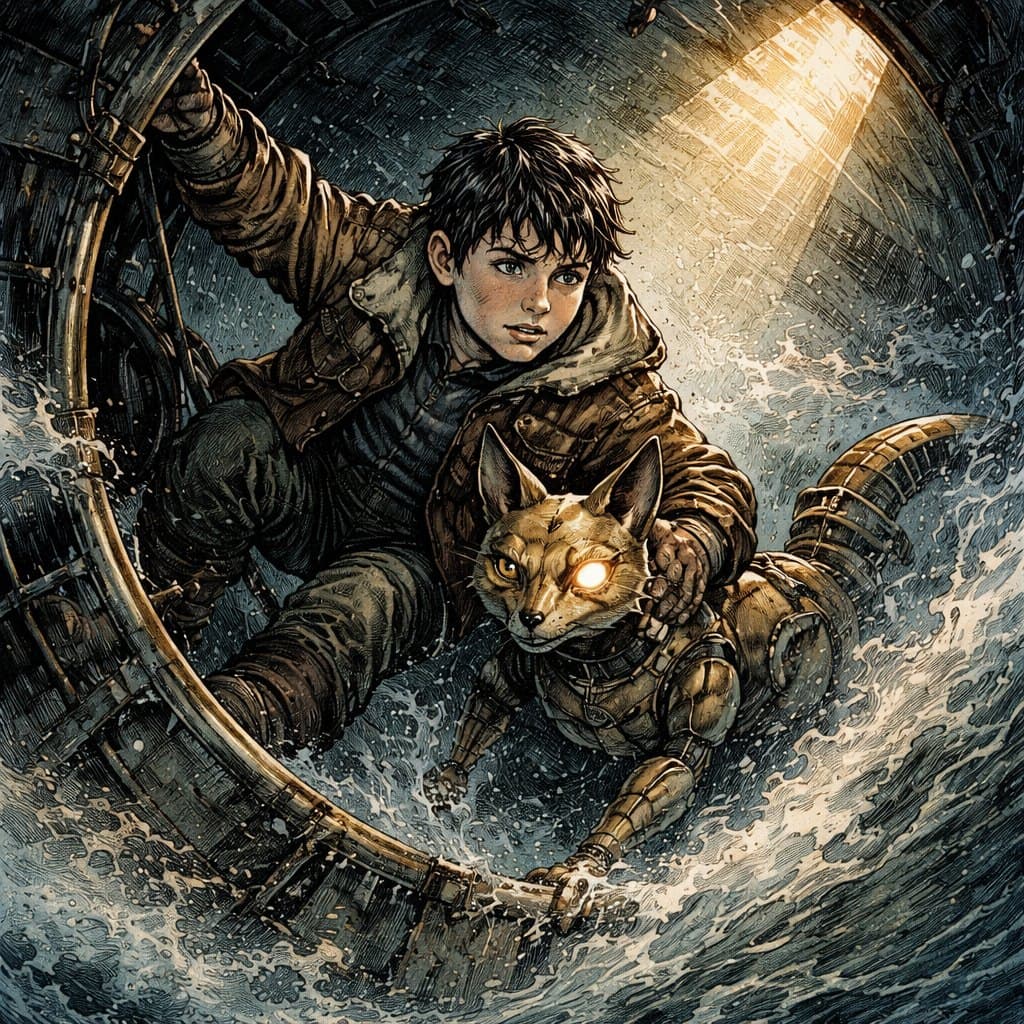
There was no outrunning it, so he did the only thing there was to do — jammed himself into the split casing, hooked one arm around a strut, and reached back with the other hand and caught Rook by the scruff as the fox came past him.
The water went over both of them.
Then it drew back. And he was still there. And so was Rook.
They came off the rocks in the last of the light and did not stop until they were forty metres up the cliff path.
Theo sat down hard on the wet stone, shaking, and it was not entirely the cold.
“You knew,” he said.
Rook looked at him with one bright eye and one dim one.
“You knew before we went down. That’s what you were doing on the path.”
He sat there a long time while the rain came in properly.
He was thinking about the year his mother built the fox. He had been six, and what he had wanted was an ordinary dog, and he could still remember the particular disappointment of being handed something made of brass instead.
She had built a thing that could read the sea.
She had built it for her son, who would grow up on a coast where wrecks came ashore and boys went down to them. And she had never explained what it was for, because she must have assumed she would be there to explain it.
And for two years he had treated it as a stubborn machine that got in his way.
“I thought you were broken,” Theo said.
Rook took two steps forward and pushed his wet plated head under Theo’s hand, which was the thing he always did, and which Theo had never once thought about.
They went up the path together in the dark.
The person looking out for you doesn’t always explain themselves.